About Huntington’s disease (HD)
- Definition: HD is a hereditary degenerative brain disorder resulting in physical and mental disabilities.
- Onset: Symptoms typically appear between ages 30-50 but can start at any age.
- Symptoms: Include cognitive, affective, behavioral and physical issues such as forgetfulness, personality changes, involuntary movements and difficulty swallowing. Each individual experiences different symptoms, which worsen over time.
- Inheritance: Each child of an affected parent has a 50% chance of inheriting the HD gene. It affects men and women equally across all racial and ethnic groups.
- Treatment: No cure or disease-modifying treatments currently exist, but symptomatic treatments are available. Extensive research is ongoing globally.
About our center
The Huntington’s Disease Society of America (HDSA) designated Centers of Excellence to provide top-tier clinical care and services to individuals with HD and their families. These centers employ a multidisciplinary team of neurologists, psychiatrists, social workers, physical and occupational therapists, among others dedicated to HD care.
Located at the WashU Medicine Section of Movement Disorders, the center serves the Midwest region, including Missouri, Kansas, Iowa, Arkansas and Southern Illinois.
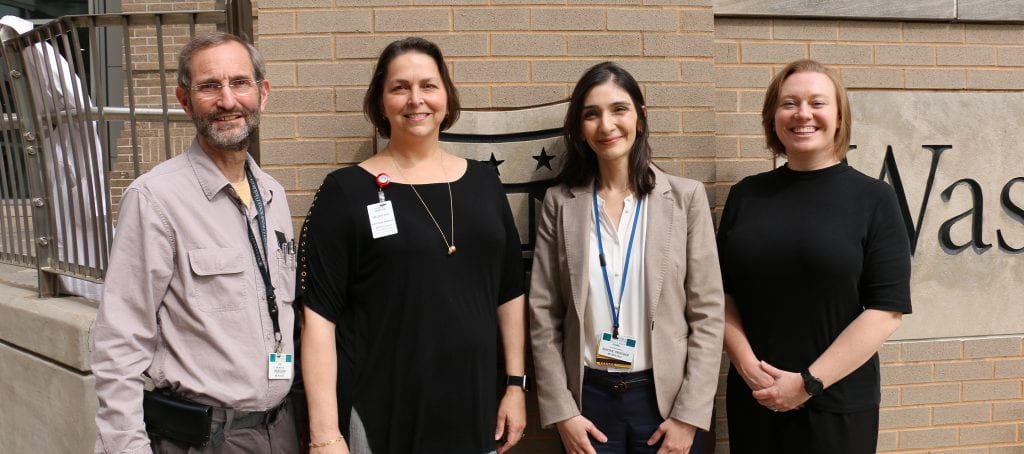
Left to right: Joel Perlmutter, Stacey Barton, Isabel Alfradique-Dunham, Alyssa Spurling
Services available
- Pre-symptomatic genetic testing
- Clinical care
- Occupational therapy
- Counseling and support groups
- Genetic counseling
- Research opportunities
- Information and referral
- Social work support
- General HD information
- In-home/nursing home visits (limited area)
- Professional education/speaker’s bureau
Research
Our staff is actively involved in HD research, including clinical trials and observational studies. Those from HD-affected families, including at-risk individuals, may be eligible to participate. For information, contact our center social worker (see below).
Pre-symptomatic genetic testing
WashU Medicine provides pre-symptomatic genetic testing to support and educate at-risk individuals interested in learning their HD gene status. This is a personal decision with far-reaching implications, requiring adequate support and readiness assessment.
Genetic testing protocol for Huntington’s Disease
Huntington’s Disease Society of America
Format: PDF
Testing protocol
- Cost considerations: Costs include pre-test counseling, genetic testing, and possibly post-test counseling. Discuss payment options with our team.
- Initial contact: Begin with a phone or email discussion with our social worker about family history, testing motivations, and cost.
- First visit:
- Social worker: Genetic/HD education and practical steps before receiving results.
- Neurologist: Neurological exam.
- Neuropsychiatrist: Emotional and behavioral risk assessment.
- Follow-up with social worker: Consent form signing and blood draw if testing proceeds.
- Second visit: Results revealed by social worker and neuropsychiatrist.
- Third visit (optional): Follow-up discussion with social worker. Ongoing counseling and support may be recommended.
Support person
Having a support person for visits is recommended. Ideally, this person should not be at-risk for HD to offer full support. Exceptions can be considered on a case-by-case basis.
Decision to forego testing
You can decide to stop testing at any time, including not having your blood drawn or choosing not to receive your results. Results are kept confidential and held for future disclosure.
Confidentiality
Confidentiality is crucial, and safeguards are in place to protect your privacy. Anonymous testing is not currently available.
Important considerations
- Minors (non-symptomatic, at-risk) are not tested.
- Counseling and referral for prenatal and preimplantation genetic testing are available.
- Significant counseling is required in cases where one individual’s results may reveal another’s gene status.
Contact us
For general inquiries, please call Stacey Barton, Clinic Social Worker
Phone: 314-362-3471
Email: bartons@wustl.edu
For other needs, such as appointments, refills, or to contact your doctor, please call the clinic at 314-362-6908 or message us through MyChart.
Resources
- Huntington’s Disease Society of America
- Huntington’s Disease Youth Organization
- HDSA National Youth Alliance
- Huntington Study Group
- HD Buzz
- National Institutes of Health Huntington’s Disease Information
- HD Trial Finder